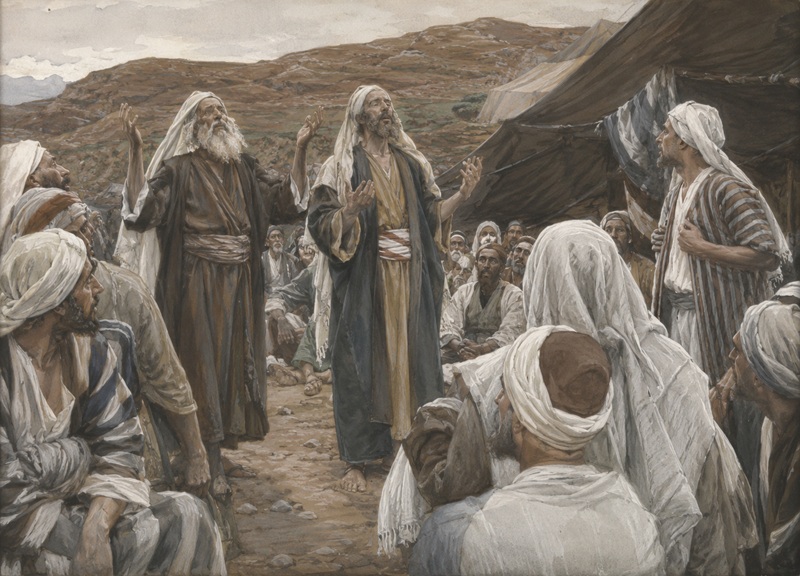
Eldad and Medad (in the style of James Tissot)
Created by ChatGPT-5.5, 2026-05-18
Descent of the Holy Spirit
el Greco, ca.1610
My dear friends,
The day of Pentecost reveals a mystery already foreshadowed in the story of Eldad and Medad. In both passages, the Spirit descends beyond the boundaries that human beings expect to contain it. Moses gathers the elders around the tent, yet the Spirit also rests upon two men who remain in the camp. The disciples gather together in one place, yet the fire of the Spirit immediately bursts outward into the many languages of the world. The Awakening Mind, which Buddhists call bodhicitta and Christians call the Holy Spirit or the mind of Christ, cannot be possessed, controlled, or monopolized. It moves where suffering calls for compassion. It appears wherever hearts become open enough to serve.
the words of the LORD,
and he gathered seventy
of the elders of the people
and placed them all around the tent.
- Numbers 11:24
When the day of Pentecost had come,
they were all together in one place.
- Acts 2:1
Both communities gather because the burden of compassionate responsibility is too great for one person alone. Moses has grown weary carrying the suffering of the people. The disciples wait together in uncertainty after the departure of Jesus. In each case, divine grace responds by creating shared participation.
The Bodhisattva path teaches the same principle. No awakened being hoards the work of liberation. Compassion naturally multiplies itself through community. The true spiritual teacher does not seek followers who remain dependent, but companions who themselves awaken and begin to serve.
and spoke to him
and took some of the spirit that was on him
and put it on the seventy elders,
and when the spirit rested upon them,
they prophesied.
But they did not do so again.
- Numbers 11:25
And suddenly from heaven there came a sound
like the rush of a violent wind,
and it filled the entire house
where they were sitting.
Divided tongues, as of fire,
appeared among them,
and a tongue rested on each of them.
All of them were filled with the Holy Spirit
and began to speak in other languages,
as the Spirit gave them ability.
- Acts 2:2-4
The Spirit descends as cloud, wind, and fire, symbols of a reality that cannot be grasped by the ego. In the Bodhisattva teachings, wisdom realizes emptiness, the open and boundless nature of all things. Yet this realization does not end in withdrawal from the world. Instead, it becomes living compassion. Fire descends upon each disciple because awakening must become embodied in each life. The tongues of flame symbolize speech transformed into compassionate action. The awakened heart learns to speak in ways beings can truly hear.
they were among those registered, but they had not gone out to the tent, so they prophesied in the camp.
- Numbers 11:26
Now there were devout Jews from every people under heaven living in Jerusalem.
And at this sound the crowd gathered and was bewildered,
because each one heard them speaking in the native language of each.
- Acts 2:5-6
Eldad and Medad receive the Spirit outside the expected place. Likewise, the message of Pentecost breaks through linguistic and cultural boundaries. The Bodhisattva learns from this that wisdom and compassion are not confined to institutions, tribes, or familiar forms. The Awakening Mind may arise in unexpected people and among those considered outsiders. Therefore one must train in humility and openness. Whenever compassion appears, wherever suffering is met with courage and mercy, there the Spirit is already at work.
"Eldad and Medad are prophesying in the camp."
- Numbers 11:27
And at this sound the crowd gathered and was bewildered,
because each one heard them speaking in the native language of each.
Amazed and astonished, they asked, "Are not all these who are speaking Galileans?
And how is it that we hear, each of us, in our own native language?
...in our own languages we hear them speaking about God's deeds of power."
All were amazed and perplexed, saying to one another, "What does this mean?"
- Acts 2:6-8,11b-12
The crowd is bewildered because genuine awakening overturns ordinary expectations. People assume holiness must appear in familiar and controllable forms. Yet the Spirit speaks through ordinary Galileans, just as Eldad and Medad prophesy away from the sacred tent. On the Bodhisattva path, compassionate wisdom manifests through skillful means. One person teaches through silence, another through acts of justice, another through tenderness, another through prophetic truth. Each being hears in their own language because compassion bends itself toward the needs of others rather than demanding conformity.
"My lord Moses, stop them!"
- Numbers 11:28
But others sneered and said, "They are filled with new wine."
- Acts 2:13
Joshua wishes to protect Moses' authority, while others mock the disciples as drunkards. Both reactions arise from fear and attachment to fixed views. The ego fears what it cannot categorize or control. Yet the Bodhisattva trains in rejoicing rather than jealousy. When goodness appears in another, one does not compete with it. When compassion flowers in unexpected places, one does not seek to suppress it. Spiritual maturity is measured by the ability to delight in the liberation and awakening of others.
Would that all the Lord's people were prophets and that the LORD would put his spirit on them!"
And Moses and the elders of Israel returned to the camp.
- Numbers 11:29-30
But Peter, standing with the eleven, raised his voice and addressed them,
"Fellow Jews and all who live in Jerusalem, let this be known to you, and listen to what I say.
Indeed, these are not drunk, as you suppose, for it is only nine o'clock in the morning.
No, this is what was spoken through the prophet Joel:
'In the last days it will be, God declares, that I will pour out my Spirit upon all flesh,
and your sons and your daughters shall prophesy,
and your young men shall see visions, and your old men shall dream dreams.
Even upon my slaves, both men and women, in those days I will pour out my Spirit, and they shall prophesy.'"
- Acts 2:14-18
Moses speaks one of the great Bodhisattva prayers of Scripture: "Would that all the Lord's people were prophets." Peter proclaims its fulfillment at Pentecost, where the Spirit is poured out upon all flesh, women and men, old and young, slave and free. This is the universal horizon of the Awakening Mind. The deepest spiritual aspiration is not private salvation or exclusive attainment. It is the liberation of all beings. The Bodhisattva vows to work until every heart is free from fear, hatred, and delusion. Pentecost reveals a community set ablaze by that vow.
My dear friends, Pentecost invites us to release every narrow understanding of spiritual life. The Holy Spirit is not a possession of the few, but the living breath of compassionate awakening moving through the whole human family. Like Eldad and Medad, we may discover grace arising in unexpected places. Like the disciples, we are called to speak words that heal division and reach hearts in their own language. Therefore let us rejoice whenever wisdom appears, whenever compassion takes flesh, and whenever another being begins to awaken. For the true sign of the Spirit is this: that love grows wider, fear grows smaller, and the suffering of the world is carried together.