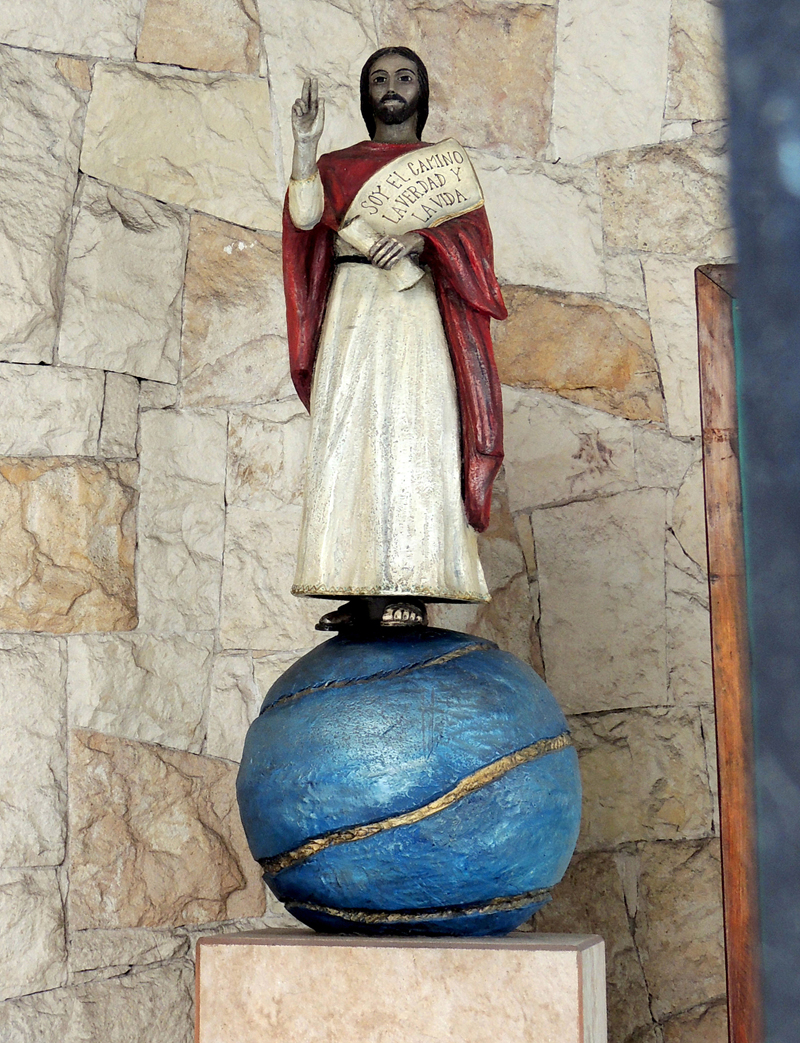
I am the Way, the Truth and the Life
Capilla Divino Maestro
Mar del Plata, Argentina, 20th Century
On this Fifth Sunday of Easter, the words of Christ invite the practitioner into a path of deep trust, expansive vision, and awakened activity. Read through the lens of the Bodhisattva path, this passage becomes a living teaching on bodhicitta, the awakened heart that unites wisdom and compassion. The “mind of Christ” may be understood as that very awakening mind, guiding beings from fear into fearless participation in reality as it is.
You believe in God; believe also in me."
- John 14:1
The troubled heart arises from grasping and uncertainty. Christ calls the disciple into trust, which for the Bodhisattva is refuge in awakened reality. Faith here is a stabilizing of the mind in bodhicitta. When one rests in this awakened confidence, fear loosens its hold, and the heart becomes a refuge for others.
- John 14:2a
The many dwelling places reveal the vastness of awakened reality. In Mahayana understanding, ultimate truth is empty and boundless, giving rise to countless skillful means. There is space for all beings, all sincere paths, all stages of awakening. The Bodhisattva learns to honor this diversity without clinging to rigid views.
And if I go and prepare a place for you, I will come again and will take you to myself,
so that where I am, there you may be also.
- John 14:2b-3
The teacher prepares the way through compassion. This mirrors the Bodhisattva vow to cultivate merit and wisdom for the benefit of others. Every act of love prepares a place in the hearts of beings. “Where I am” points to abiding in awakened awareness, which is not distant but realized through practice here and now.
Thomas said to him, "Lord, we do not know where you are going. How can we know the way?"
Jesus said to him, "I am the way and the truth and the life.
No one comes to the Father except through me."
- John 14:4-6
Christ as “the way, the truth, and the life” can be understood as the unity of path, view, and fruit. The way is compassion in action, the truth is realization of emptiness, and the life is spontaneous benefit for beings. No one comes to ultimate reality through ego; one enters through awakened mind, through bodhicitta.
Philip said to him, "Lord, show us the Father, and we will be satisfied."
Jesus said to him, "Have I been with you all this time, Philip, and you still do not know me?
Whoever has seen me has seen the Father. How can you say, 'Show us the Father'?
Do you not believe that I am in the Father and the Father is in me?
The words that I say to you I do not speak on my own, but the Father who dwells in me does his works."
- John 14:7-10
This is a direct pointing to non-duality. The form of the teacher and ultimate reality are not separate. In Buddhist language, appearance and emptiness are inseparable. The awakened one acts without a separate self; the “Father” works through him. The Bodhisattva trains in this same realization, allowing compassionate activity to arise without grasping at a doer.
but if you do not, then believe because of the works themselves."
- John 14:11
Faith matures through experience. If realization is not yet stable, one examines the fruits of practice. Do actions reduce suffering and increase compassion? This is the test. In this way, belief becomes grounded in lived transformation rather than concept alone.
and, in fact, will do greater works than these, because I am going to the Father.
I will do whatever you ask in my name, so that the Father may be glorified in the Son.
If in my name you ask me for anything, I will do it."
- John 14:12-14
Here the disciple is empowered. “Greater works” arise when awakened mind manifests through many beings. This is the multiplication of bodhicitta across the world. To ask “in my name” is to align intention with that awakened mind. When motivation is free from self-centered grasping and grounded in compassion, actions harmonize with reality and bear profound fruit.
This Gospel reveals the path in its fullness: trust that calms the heart, wisdom that sees non-duality, and compassion that acts without self. To walk this way is to embody the mind of Christ as bodhicitta itself. Then, even now, one abides where Christ abides, participating in the ongoing work of liberating all beings.