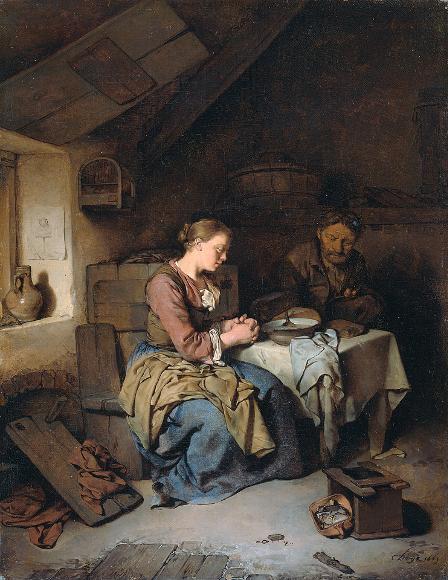
Saying Grace
Cornelis Pietersz. Bega, 1663
My dear friends,
In the quiet interior of Bega’s Saying Grace, we behold a humble meal transformed by attention, gratitude, and shared devotion. Nothing in the room is grand: the bench is worn, the cloak is rough, the provisions are simple. Yet the act of prayer gathers these ordinary elements into a deeper unity. So too in the early Church described in Acts, where discipleship did not depend on wealth or status, but on a shared life oriented toward God. This shared life finds a close parallel in the Buddhist concept of sangha: a community bound not merely by proximity, but by a common commitment to awakening, mutual care, and the transformation of daily life into a path.
to the apostles' teaching and fellowship,
to the breaking of bread and the prayers.
- Acts 2:42
The life of the early believers is marked by four interwoven practices: teaching, fellowship, the breaking of bread, and prayer. These are not separate activities but facets of a single orientation—a life turned toward truth and sustained in community. In Buddhist terms, this is the functioning of the sangha, where the Dharma is learned, embodied, and reinforced through shared practice. The breaking of bread, like the simple meal in the painting, becomes more than nourishment; it is a site of recognition, where the ordinary is received as grace. Prayer, like meditation, gathers the scattered mind and reorients it toward what is ultimate.
- Acts 2:43
Awe arises not merely from extraordinary events, but from the unveiling of a deeper order within ordinary life. When the mind is rightly oriented—through prayer, through mindfulness, through shared devotion—what was once unnoticed becomes luminous. In both the early Christian community and the sangha, signs and wonders are less about spectacle than about transformation: hearts softened, perceptions clarified, relationships reordered. The light that falls quietly across the room in Bega’s painting is akin to this awakening—subtle, but sufficient to reveal the presence of grace.
they would sell their possessions and goods and distribute the proceeds to all, as any had need.
- Acts 2:44-45
Here the inward transformation takes visible form. The community’s sharing of goods is not an imposed system, but the natural expression of a changed heart. When the illusion of separateness loosens—as both Christian love and Buddhist wisdom affirm—generosity arises spontaneously. The sangha exists precisely to support this shift, creating conditions in which mutual care replaces self-centered accumulation. The broken bench and rough cloak in the painting remind us that material conditions may remain modest, even fragile; yet within such conditions, a deeper wealth is discovered and shared.
they broke bread at home and ate their food with glad and generous hearts,
praising God and having the goodwill of all the people.
- Acts 2:46-47a
The rhythm of temple and home, of public worship and private meal, reveals that the sacred is not confined to one place. Every table may become an altar; every shared meal, a participation in grace. This is the essence of both the early Christian fellowship and the sangha: the integration of practice into daily life. Gladness and generosity arise not from abundance, but from right relationship—to God, to one another, and to the present moment. Even the simplest food, received with awareness, becomes a source of joy and praise.
- Acts 2:47b
Growth here is not the result of strategy, but of authenticity. A community that embodies truth, generosity, and joy becomes naturally attractive. In Buddhist terms, a healthy sangha draws others not by persuasion, but by the quiet clarity of its life. So too the early Church: its expansion is the outward sign of an inward reality. The light that enters the humble room does not remain confined; it spills outward, inviting others to step into its warmth.
Thus we see that discipleship does not require extraordinary circumstances. Like the figures in Bega’s painting, we are invited to begin where we are—with the food before us, the companions beside us, the light already given. In such a setting, the community of faith becomes a true sangha, a fellowship in which the ordinary is transfigured. Even from the humblest hand, the Bread of Life may be shared; even in the smallest corner, the light of grace may shine.